Desires and Contradictions:
Exhibiting Art and Architecture
in Slovenia 1947–1979
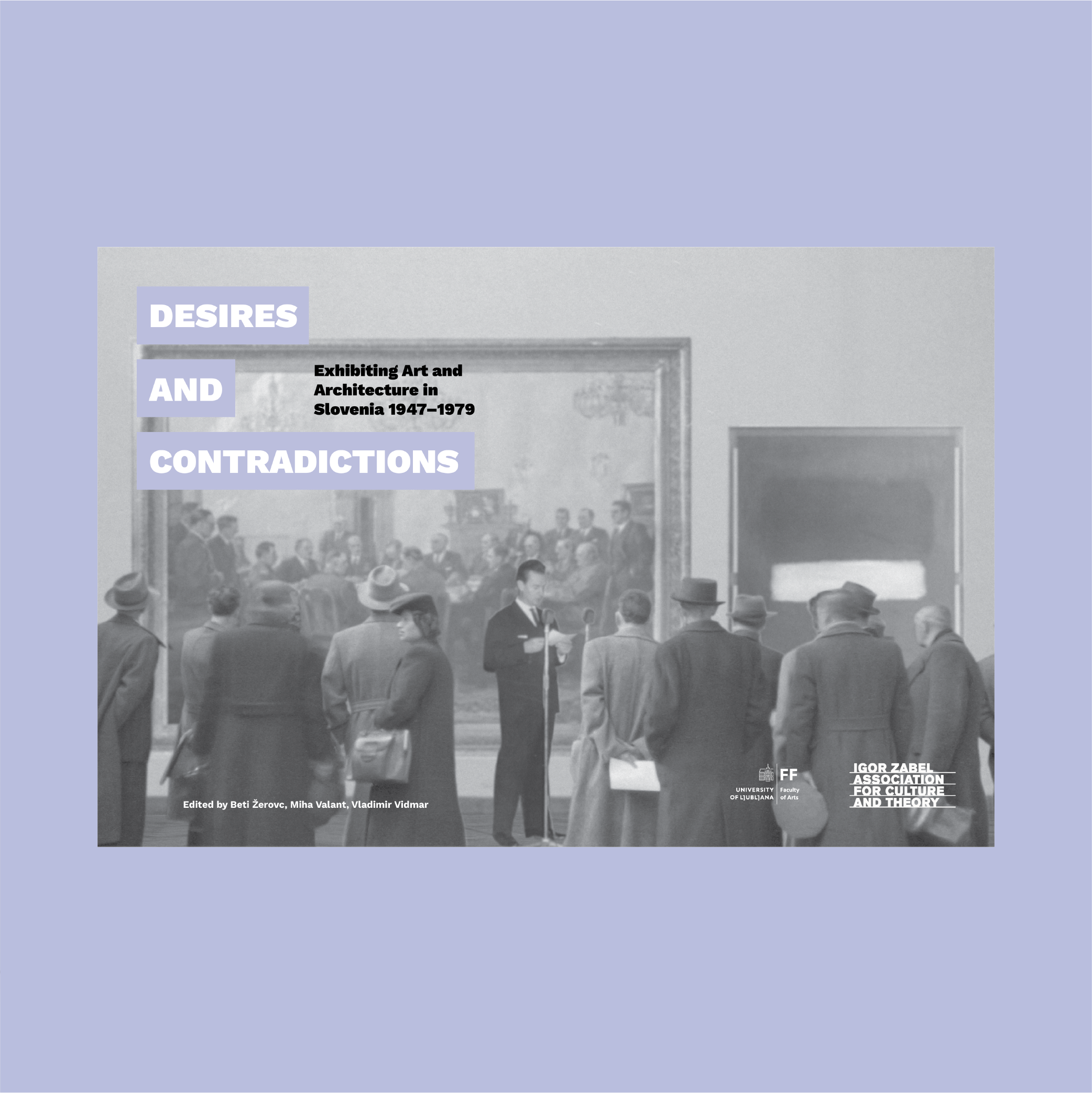
The period addressed by the monograph Desires and Contradictions: Exhibiting Art and Architecture in Slovenia 1947–1979 is framed by two exhibitions which, through their organisation, content orientation, the selection of works and the responses they elicited, tellingly reflect the historical situation of their time. The guest show Exhibition of Soviet Painters (Museum of Modern Art in Ljubljana, 1947) is representative of the brief period of the Yugoslav rapprochement to the Soviet Union in the field of art – a rapprochement that, in Slovenia, remained limited and ended in 1948 following Yugoslavia's expulsion from the Cominform. The second exhibition, the large retrospective Slovenian Fine Arts 1945–1978 (Museum of Modern Art in Ljubljana and Architectural Museum Ljubljana, 1979), presented a broad spectrum of architecture, design and art, yet through its specific mode of presentation and interpretation, it also confirmed modernism as the most important current of Slovenian artistic production of the preceding period.
Within this framework, the monograph examines selected art and architecture exhibiting examples against the backdrop of Yugoslavia's political and social conditions, observing them through the prism of the Yugoslav political order, its doctrine and its geopolitical prospects. Through case studies, it explores the factors that decisively shaped art and culture in relation to exhibiting, as well as how these fields operated in relation to the state: whether they adhered to and reinforced the official ideology or distanced themselves from it. The chapters consider what the exhibitions articulated and how – both in relation to the national aspirations of individual Yugoslav nations and the question of a shared cultural identity, as well as considering how they were presented internationally.
Insight into the organisation of these events in Slovenia also provides a broader understanding of the exhibition as a medium and of the functioning of art institutions. In the context of the Cold War, both the exhibitions and the institutions emerge as willing collaborators with the political-economic systems and as conveyors of their ideologies – even if not necessarily those that one might have expected.
Publishers: Založba Univerze v Ljubljani in Društvo Igor Zabel za kulturo in teorijo, 2026